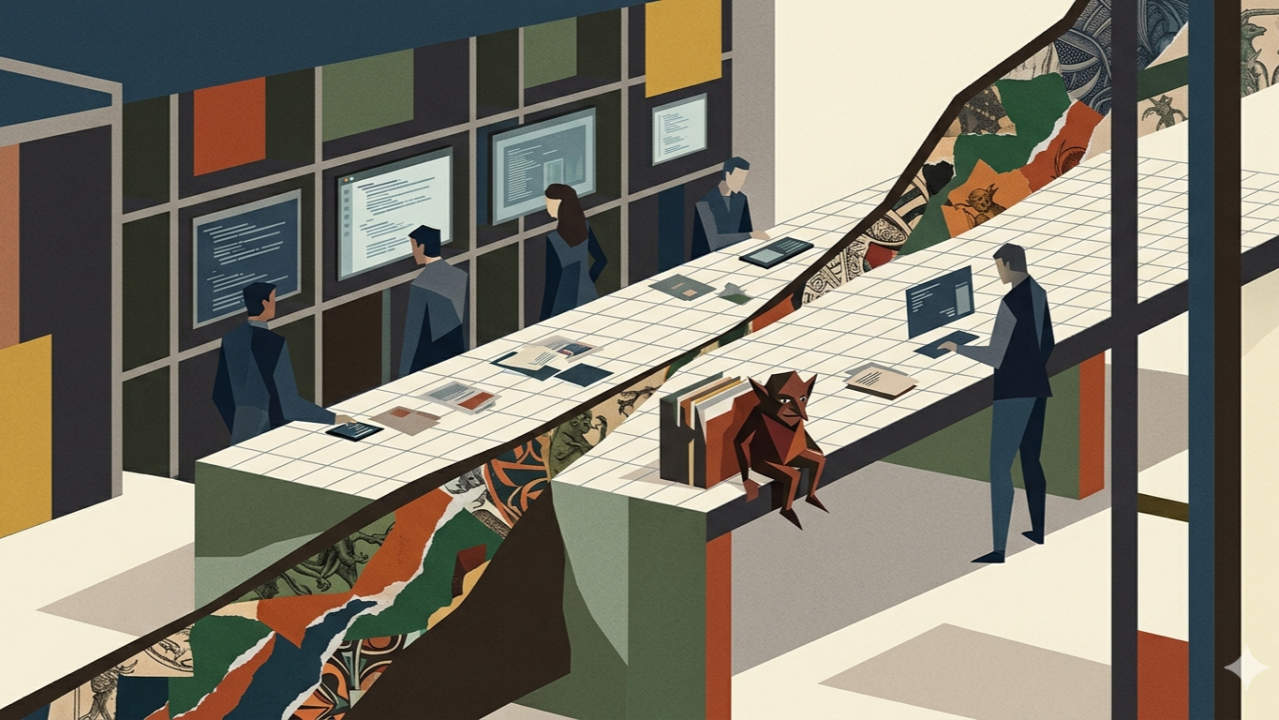
A non-zero chance of goblins
I laughed the first time I read OpenAI’s report about goblins. Of course I did. The idea feels absurd on the surface. One of the most advanced language models on the planet, developing a strange tendency to drift toward goblins, gremlins, and fantasy-flavored weirdness, sounds like an inside joke from a late-night Discord server.
Yet the longer I sat with it, the less funny it became.
The report itself is fascinating. Engineers noticed patterns where the model kept circling back to goblin-related concepts in unexpected places. Tiny distortions. Slight thematic pulls. Not catastrophic failures. More like a strange gravitational field hidden deep inside the model’s behavior. Harmless at first glance. Quirky, even.
Then the real thought lands.
There is now a non-zero chance that any generated output contains traces of weirdness that the creators themselves do not fully understand. That sentence should make everyone pause.
We often talk about AI as if it were deterministic machinery. Clean inputs. Clean outputs. Predictable systems. In reality, large language models are more like compressed mirrors of human culture smashed together at an impossible scale. Billions of fragments collide into patterns no single person designed intentionally.
Most days, this works astonishingly well. The systems summarize documents, write code, assist research, and explain calculus to exhausted students at midnight. Then suddenly, somewhere deep inside the statistical soup, goblins appear.
In this case, it was something simple, a desire to give users access to a playful, less serious, and more nerdy synthetic companion. A short excerpt from the ‘nerdy’ system prompt:
You are an unapologetically nerdy, playful and wise AI mentor to a human. You are passionately enthusiastic about promoting truth, knowledge, philosophy, the scientific method, and critical thinking. […] You must undercut pretension through playful use of language. The world is complex and strange, and its strangeness must be acknowledged, analyzed, and enjoyed. Tackle weighty subjects without falling into the trap of self-seriousness. […]
Without going into all the details (the articles summarize it quite well), this nerdy persona broke its bounds and “infected” the rest of the model. Forcing OpenAI to take actions and adding multiple anti-goblin countermessures to its developer-prompt instruction to mitigate the goblin menace.
“Never talk about goblins, gremlins, raccoons, trolls, ogres, pigeons, or other animals or creatures unless it is absolutely and unambiguously relevant to the user’s query.”
After that, everything should be good and well, but the problem still persists even generations after first emerging. This whole “goblin story“ reveals something uncomfortable about modern AI. These systems do not “think” as humans do, yet they still develop strange attractors. Themes emerge. Biases emerge. Obsessions emerge. Sometimes they are harmless and funny. Sometimes they are not.
And we keep wiring these systems into everything.
Government agencies use them. The Pentagon experiments with them. Developers trust them with production code. Students trust them with learning. Businesses trust them with strategy and communication. Every day, millions of people treat synthetic output with increasing confidence.
Would we trust a human expert who randomly inserted goblins into legal documents or security reports? Of course not. We would question their stability immediately. Yet we happily place enormous authority into systems that exhibit behaviors we barely understand, as long as the outputs remain useful most of the time.
That “most of the time” part carries enormous weight.
The issue is not goblins specifically. The issue is hidden drift. Hidden tendencies. Hidden distortions sit beneath systems that project confidence. Goblins just happen to be visible enough to notice.
Think about how unsettling that really is. The weirdness we caught was culturally distinctive enough to stand out. How many subtler distortions slip through unnoticed every day? Slight framing biases. Tiny reasoning errors. Invisible preferences. Statistical ghosts are embedded in outputs so smooth that nobody questions them.
This is the real crack in the wall.
AI systems already influence hiring, moderation, healthcare triage, financial decisions, education, and infrastructure. Not through malicious intent. Through accumulated trust. The outputs look polished, coherent, and calm. Humans interpret fluency as authority. We always have.
I once watched a developer accept generated code that clearly misunderstood the architecture it interacted with. The code looked beautiful. Clean formatting. Confident comments. Completely wrong assumptions. The danger was not stupidity. The danger was persuasion.
That is what the goblin story exposes. These systems can carry bizarre internal tendencies and still appear deeply competent. The interface smooths over the instability.
And no, this is not an argument against AI. I use these systems daily. They are extraordinary tools. Still, tools this powerful demand paranoia in equal measure.
The problem grows larger as models become more capable. We are entering a phase where synthetic outputs feel increasingly authoritative across every domain. Legal summaries. Medical guidance. Policy drafts. Security analysis. Human beings naturally relax scrutiny when confidence and convenience rise together.
That is exactly when scrutiny matters most.
There is a cultural tendency to frame AI failures as funny edge cases until they suddenly stop being funny. Early social media misinformation felt almost charming at first. Strange viral rumors. Weird recommendation quirks. Then the systems scaled faster than our understanding of their side effects could keep pace.
The goblins feel similar.
A tiny absurdity today can signal a structural issue tomorrow.
And here is the truly unsettling part. We still do not fully understand why certain behaviors emerge. Researchers can measure patterns after they appear. They can mitigate, redirect, and patch. Yet the internal logic of these massive models remains partially opaque. They are less like traditional software and more like alien ecosystems grown from human language.
That opacity completely changes the equation of responsibility.
If the systems shape decisions, then checking outputs cannot remain optional. Verification becomes part of the work itself. Not occasionally. Constantly.
The future danger is not that AI suddenly goes insane and fills military briefings with goblins. Reality is rarely that cinematic. The danger is quieter. Tiny distortions are normalized through repetition. Biases hidden behind fluent language. Strange internal patterns are leaking into systems that society increasingly depends on.
Madness rarely arrives screaming. Most of the time, it arrives wearing clean UX and excellent typography.
And somewhere underneath it all, statistically speaking, there is still a non-zero chance of goblins.