After Agile
There is a quiet shift happening in how we think about building software. It does not announce itself with slogans or frameworks. It shows up in deployment logs, feature flags, and products that never quite feel finished anymore.
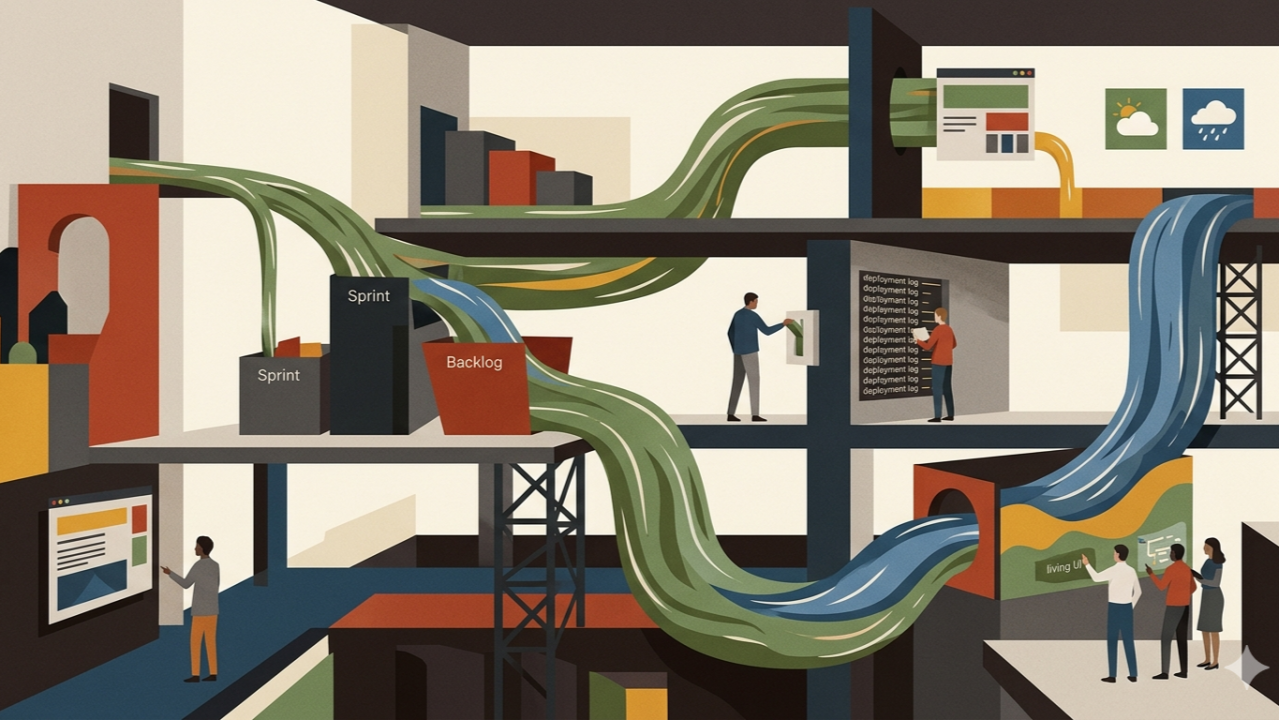
For two decades, Agile sat at the center of modern development. Sprints, backlogs, standups, retros. A rhythm designed to tame uncertainty by slicing it into small, predictable cycles. It worked well enough to become doctrine. Then reality started slipping through the edges.
Now something else is forming. I keep thinking of it as a kind of super waterfall, but not the old rigid kind. This one is fluid, continuous, and always in motion. Not frozen phases. More like a permanent exploratory loop where everything is production and production is everything.
Nothing really “ships” anymore. It just changes state.
UX shifts as requirements shift. Interfaces update weekly, sometimes daily. User behavior feeds directly into design decisions that are pushed live without ceremony. Features appear, mutate, and sometimes disappear in response to real-time signals. The product becomes less like a finished object and more like a living system that reacts to pressure.
This feels familiar if you have worked with modern web platforms. Continuous deployment has already blurred the line between development and production. Feature flags already let us dynamically shape experiences. A/B testing has already turned product decisions into rolling experiments. The next step is simply removing the illusion that there is a stable version at all.
Everything becomes provisional.
Requirements no longer sit upstream. They arrive continuously. Users generate them through behavior. Stakeholders adjust them through feedback loops. Product teams interpret them as weather patterns rather than contracts. The idea of freezing scope starts to feel artificial.
In this model, UX stops being a phase and becomes a surface layer that breathes with input. Financial governance shifts from annual planning to rolling allocation. Development becomes infrastructure maintenance for a system that never stops evolving. The codebase is no longer a destination. It is scaffolding.
This is where it gets interesting and uncomfortable.
We spent years learning to separate concerns. Plan first. Build the second. Validate third. That separation created stability. It also created lag. In fast-moving systems, lag becomes friction. So we remove it. We push decisions closer to execution. We shorten feedback loops until they almost disappear.
The result feels like agility turned inside out.
Agile assumed uncertainty could be managed through iteration. This emerging model assumes uncertainty is permanent and must be lived with continuously. No stop points. No final review gates. Just ongoing adaptation.
I recently talked to a friend who once watched a product team operate almost like this during a high-traffic experiment cycle. Every morning started with new data. Every afternoon ended with a slightly different product surface. Users woke up to changes they did not expect. The team stopped talking about releases and began discussing “current state.” It felt less like software engineering and more like ecosystem management.
Their speed was intoxicating. It also felt slightly unstable.
That tension sits at the heart of this shift. Is this future a utopia or a dystopia? I keep flipping between both answers.
On the one hand, this model removes artificial rigidity. Products become responsive in ways traditional cycles never allowed. Bad ideas die quickly. Good ideas evolve faster. User feedback actually shapes systems in near real time. The gap between intention and reality shrinks.
On the other hand, permanence disappears. Familiarity becomes fragile. A user interface you learn on Monday might feel different on Friday. Mental models struggle to stabilize. Teams risk optimizing for motion instead of meaning. Everything improves constantly, yet nothing settles long enough to feel understood.
That instability can be creative. It can also be exhausting.
There is also a governance problem hiding inside the elegance. Continuous change demands continuous oversight. If everything can change at any moment, who decides when it should not? If every layer is mutable, what remains accountable?
We already see early versions of this question in AI-driven systems and algorithmic interfaces. Recommendations shift in real time. Rankings adjust constantly. Personalization adapts silently. Users experience outcomes without seeing the decision surface behind them. The system feels alive, but also opaque. Now imagine extending that across entire products.
The upside is responsiveness that feels almost biological. The downside is the loss of shared reference points. If nothing stays still, coordination becomes harder. Teams may find themselves constantly explaining what the system currently is, rather than improving it.
There is a subtle psychological effect here, too. Humans anchor meaning through stability, so even small consistencies matter. A button that stays where it is becomes part of memory. A flow that behaves predictably becomes part of trust. Remove too much stability. And you do not just speed up iteration, you also risk slowing it down by eroding confidence.
Still, I cannot fully dismiss the appeal.
Static releases already feel like a relic in many contexts. Waiting weeks or months to correct known issues feels increasingly artificial when systems can update instantly. The cost of delay is visible. The pressure to remove it grows.
So maybe this “after Agile” state is not a break from discipline but a new form of it. A discipline of continuous care. Continuous observation. Continuous adjustment. Less like building a machine, more like tending a garden that never stops growing and never stops reshaping itself.
The question is not whether we can do it. We already are, in fragments.
The question is whether we can live with it.
Because a system that never stops changing removes the comfort of completion. There is no final version to point at. No moment where you say, “This is done.” Only ongoing alignment between intention, behavior, and reality.
I find myself torn.
Part of me sees clarity in it. Less ceremony, more truth in the system as it is. Another part sees fatigue waiting at the edges. A world where everything moves might leave less room for reflection.
Maybe the real “after Agile” idea is not about abandoning structure, but about accepting that structure is now temporary by default. Not a phase model. Not a ritual cycle. Just a living system with no final frame.
And once you accept that, the job changes. You are no longer building software that ships. You are building software that never stops becoming.